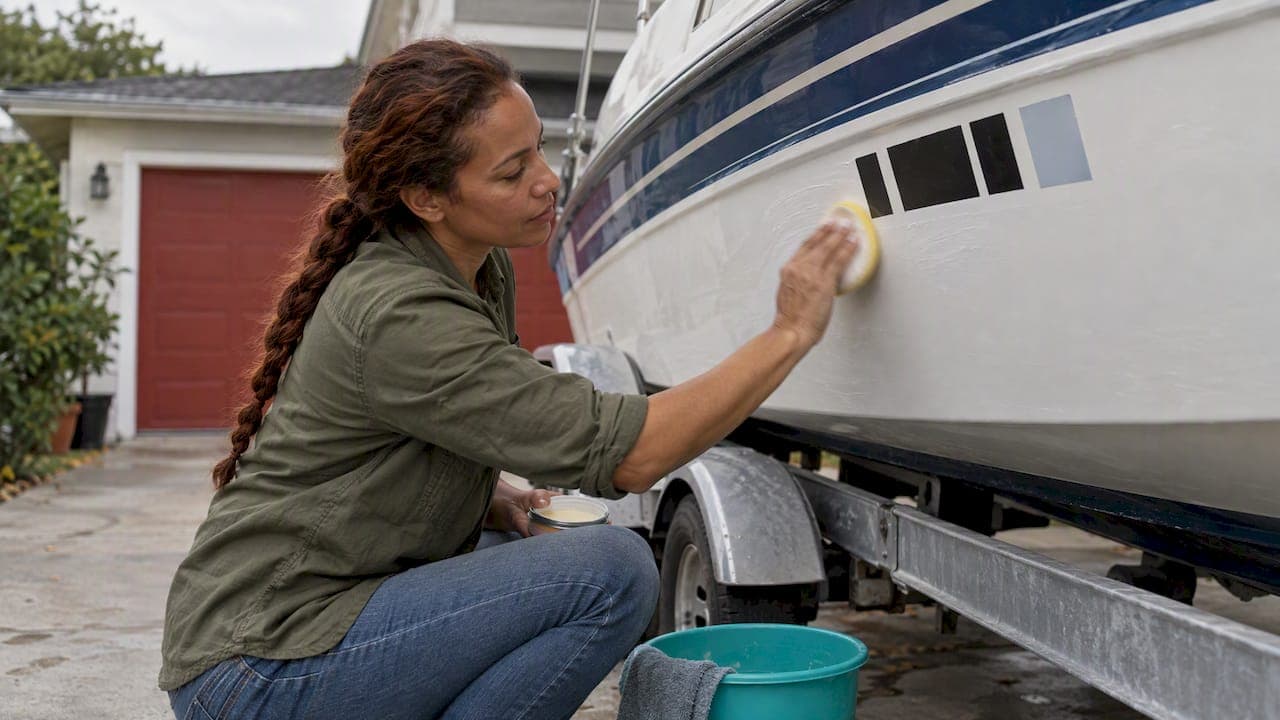
Short answer: you can wax a hull that has vinyl registration numbers on it, but you shouldn't wax the numbers themselves. Film makers say wax and wax-based cleaners weaken the bond at the edges of a graphic, and edges are where lifting starts. The safe routine is simple. Let the decals cure, tape them off, wax the gelcoat around them, then clean and protect the vinyl with a product made for vinyl.
This guide covers what wax does to marine vinyl, how long to wait after installing, what to avoid, and a step-by-step method for waxing around your numbers.
TL;DR
- Wax the hull, not the numbers. Mask the vinyl with blue painter's tape before you wax.
- Wait at least 48 hours after application before the decals see use or wax, so the adhesive can fully wet out.
- Many hull waxes contain cleaners and solvents meant for gelcoat, and those can degrade vinyl or weaken its edges.
- Clean vinyl with mild soap and fresh water, then use a silicone- or Teflon-based vinyl protectant if you want extra protection.
- Never apply new decals over wax. The surface has to be wax-free first.
Table of Contents
- Can you put wax on vinyl boat numbers?
- What wax actually does to vinyl numbers
- How long to wait after applying numbers before waxing
- Waxing before you apply the numbers
- How to wax a hull without damaging the numbers
- What to avoid on and around vinyl numbers
- Clean and protect vinyl numbers instead of waxing them
- Our perspective: protect the edges, not the face
- Replacing numbers that wax already damaged
- Get a new set that's built to be cared for
- FAQ
- Sources
Can you put wax on vinyl boat numbers?
It depends on what you mean by "put wax on." Boat forum threads and detailing posts split on this. Some owners say a long-cured set of letters shrugs off conventional wax. Others say wax degrades vinyl over time and recommend sticking to a vinyl-specific protectant instead. Both camps agree on one thing: it is the edges that suffer, and a careless buffer pass across a lettering edge is how corners lift.
The manufacturers whose film is used on boats are more cautious than the forums. 3M's watercraft bulletin says marine wax can greatly reduce graphic adhesion, and that solvent-based cleaners are needed to remove wax residue thoroughly, because alcohol-based cleaners do not remove it effectively. That is a statement about adhesion, not about the look of the vinyl, and it matters most where the film meets the hull.
So the practical answer is this. Treat the vinyl as something you work around, not something you polish. Registration numbers are small compared with a hull, and masking them costs you ten minutes.

What wax actually does to vinyl numbers
Three things can go wrong, and they are different problems.
Wax weakens the edge bond
Vinyl numbers hold on through a pressure-sensitive adhesive. Wax is a slippery, hydrophobic film. If it creeps under a lifted corner or soaks into the edge, the adhesive has less to grab. 3M's guidance on watercraft graphics is blunt that wax contamination compromises adhesion, and it tells installers to avoid soaps or preparations containing wax when cleaning the surface.
Built-in cleaners attack the film
Many "cleaner wax" and polish products are formulated for paint and gelcoat. Shurhold, a marine care brand, explains that many hull-wax products contain built-in cleaners intended for those surfaces, and those cleaners can degrade graphics. If the label says cleaner, compound, or polishing wax, assume it is aimed at the gelcoat, not your letters.
Harsh chemistry breaks down the surface and adhesive
Avery Dennison's care bulletin for PVC films warns that solutions outside a pH range of 3 to 11 can damage the clear coat or laminate on a graphic and may break down adhesive at the edges, leading to lifting or separation. Strongly alkaline hull cleaners and acidic oxidation removers are the usual culprits on a boat.
None of this means one pass of a mild wax will ruin your numbers. It means the risk is real, it builds with repetition, and it is easy to avoid.
How long to wait after applying numbers before waxing
Fresh decals need time. The adhesive on a new decal keeps flowing into the microscopic texture of the hull for a while after you squeegee it down.
- 48 hours before use. Arlon's marine marking guidance recommends giving graphics 48 hours for complete adhesive wet-out before the boat is used. Treat that as the minimum before any cleaning product touches the area, too.
- Keep it warm. For 3M watercraft graphics, the post-application instruction is to keep the surface above 60°F (16°C) for at least 24 hours before exposing the film to cold or wet conditions. A boat shrink-wrapped in a cold garage is not a good place to cure decals.
The manufacturers do not publish a magic number of weeks before waxing is "safe." Some owners say a few weeks of cure is enough for conventional wax. We would rather give you a rule that doesn't depend on guessing: wait the full 48 hours at minimum, give the vinyl a few extra days if you can, and then mask it anyway.
Waxing before you apply the numbers
The reverse problem is more common than waxed-over decals: new numbers going onto a freshly waxed hull. Here the manufacturers and the states agree.
- North Carolina's official vessel-number instructions say the surface must be clean, dry, and free of dust, grease, wax, and other foreign matter before decals go on. That is application guidance, not a ban on waxing afterward, but it shows how seriously agencies treat wax under adhesive.
- Avery Dennison's preparation guidance says the substrate must be free of dirt, oil, grease, solvent residue, and wax, and it advises avoiding detergents that contain lotions, waxes, creams, or oils.
- 3M adds that the surface should be cleaned immediately before film application, because wax residue can prevent proper adhesion.
If your hull is already waxed and you need new numbers, we wrote a separate walkthrough: 5 manufacturer-backed steps to make decals stick on waxed hulls. And if you plan a ceramic coating, put the decals on first, as explained in why to apply decals before ceramic coating.
How to wax a hull without damaging the numbers
This is the method we recommend, built from Shurhold's masking approach and the film makers' care guidance.
- Wash the hull first. Start with a clean hull so you are not grinding grit across the vinyl. Rinse with fresh water.
- Mask the vinyl. Shurhold's advice is to mask the vinyl with blue painter's tape before waxing. Cover each digit and letter, and leave a small margin of tape onto the gelcoat so wax doesn't settle against the edge.
- Wax by hand near the numbers. Don't run a rotary or orbital polisher across the lettering. Work the wax up to the tape line and stop.
- Remove the tape promptly. Pull it off while the wax is still hazy or just after you buff, so dried wax doesn't bond the tape down.
- Wipe stray wax off the vinyl. Use a clean microfiber and fresh water with a little mild soap. Don't use a solvent on the film itself.
- Finish the vinyl separately. Shurhold suggests spraying the vinyl afterward with a nonabrasive detailing product that cleans, polishes without abrasives, repels water, and adds UV protection.
For most boats this adds a few minutes to a waxing job. On a center console or bass boat with numbers on both sides of the bow, plan on about ten minutes of taping. If you have not placed your numbers yet, our guides on where registration numbers go on a boat and on whether numbers go on both sides will help you plan the masking.
What to avoid on and around vinyl numbers
| Avoid | Why |
|---|---|
| Cleaner waxes, compounds, polishing waxes near the letters | Built-in cleaners aimed at gelcoat can degrade graphics |
| Petroleum-distillate or solvent-heavy products | Solvents can soften or damage the film and the adhesive edge |
| Acetone, MEK, lacquer thinner | Arlon warns against these harsh solvents in marine graphic prep |
| Ammonia-based cleaners | Avery Dennison says they affect adhesive polymer stability |
| Cleaners outside pH 3 to 11 | Can damage the clear coat or laminate and break down edge adhesive |
| Machine polishing across the vinyl | Heat and friction catch edges and lift them |
A note on acetone: The Watercraft Journal's installation guide cautions that acetone can permanently damage some painted watercraft surfaces, so it is a poor choice even for prep. A mild solvent or glass cleaner is the gentler way to remove fingerprints and oils before applying decals.
Clean and protect vinyl numbers instead of waxing them
The best "wax" for vinyl numbers is a good wash routine.
Avery Dennison's maintenance bulletin gives the sequence: rinse first to remove loose dirt, wash top-down with clean water and mild detergent in the pH 3 to 11 range, rinse again, then air-dry or dry with microfiber. The same bulletin says a silicone- or Teflon-based polish designed specifically for vinyl graphics may be used for extra protection, following the product directions.

Arlon's marine guidance also points to mild soap and water, a soft sponge, and a fresh-water rinse. It recommends an overlaminate to reduce abrasion and oxidation risk. If you want numbers that last, laminate matters more than any polish. Our pieces on making decals last 7 to 10 years with overlaminate and what to check when choosing laminate go deeper, and how long marine vinyl decals last explains the real-world lifespan.
Pressure washing
Washing is where many decals die, not waxing. Arlon's North American vinyl guidance says improper pressure washing can degrade vinyl or lift edges, and sets these limits for pressure washing:
- 1,300 PSI maximum
- About 140°F (60°C) maximum water temperature
- At least five feet from the graphics
- A spray angle no shallower than 60 degrees from perpendicular
Never aim a jet along an edge. That is how water gets under the film.
Our perspective: protect the edges, not the face
We produce registration decals in-house from marine-grade vinyl chosen for UV and saltwater resistance, so the question of what happens to numbers after the hull gets detailed comes up constantly. Our view is that the vinyl face is rarely what fails. The edge is.
That is why we stop short of telling anyone to wax right over their numbers, even though some owners do it for years without trouble. A waxed edge is a gamble you take for no gain. Registration numbers have a legal job: they have to be readable and attached, and state rules on size, contrast, and placement still apply when the decal looks tired. Tape costs almost nothing compared with reordering a set.
A few habits we suggest to every customer:
- Let new numbers sit for 48 hours before use, and keep them above 60°F for the first day.
- Tape, wax, untape, then finish the vinyl with a vinyl-safe protectant.
- Choose a material and thickness that suit your use. Our posts on the best vinyl for boats and vinyl thickness for boat numbers explain the trade-offs.
- If an edge does lift, deal with it early. Trim, clean, and re-stick only if the adhesive still holds. Otherwise replace the decal.
— Taylor
Replacing numbers that wax already damaged
If you waxed over old numbers and corners are curling, don't keep polishing. Peel the set off, clean the hull of wax thoroughly (this is where the solvent-versus-alcohol difference from 3M matters), and start fresh. Our guide on how to remove old boat registration decals walks through it without damaging the gelcoat.
Before ordering, check your state's rules for number height, color contrast, and spacing. We keep a page of boat registration decal regulations for all 50 states, so you can confirm the requirements for your waters. If you use vinyl rather than paint, here is whether registration numbers can be vinyl decals.
Get a new set that's built to be cared for
We make custom, state-compliant boat registration numbers from marine-grade, UV-resistant, saltwater-proof vinyl. You enter your registration number, pick colors and fonts in our online design tool, and check the preview in minutes. Sets start at $35.99 per set, production takes 3 to 5 business days, and shipping is free across the contiguous United States.
We also have dedicated pages for jet ski numbers, pontoon numbers, bass boat numbers, aluminum boat numbers and center console numbers. Ready to order? Design your custom boat registration numbers and have them on the hull, unwaxed and wax-free underneath, within the week.
FAQ
Can I put wax on vinyl?
Yes, the vinyl will survive casual contact, but it is not recommended. Wax can reduce edge adhesion, and many hull waxes contain cleaners that can degrade graphics. Mask the numbers with blue painter's tape and use a vinyl-specific protectant on the vinyl itself.
What is a good sealer for vinyl decals?
For boat numbers, the film manufacturers' answer is not a sealer but a protective overlaminate on the decal, plus a silicone- or Teflon-based polish made specifically for vinyl graphics. Follow the product directions. Avoid petroleum-heavy or solvent-based coatings, and don't brush on household sealers.
Can I use polyurethane over a vinyl decal?
We don't recommend it. Coatings like polyurethane aren't made to flex with marine vinyl and can trap solvents against the adhesive edge, and none of the manufacturer guidance we reviewed endorses them. A laminated decal and regular gentle washing protect better and keep the numbers legible.
Will wax stop new numbers from sticking?
Yes. 3M, Avery Dennison and North Carolina's vessel-number instructions all call for a clean surface free of wax before application. Wash the area, use an appropriate solvent to remove wax residue, dry it completely, and then apply the decals.
Sources
- 3M, Application: Watercraft (instruction bulletin)
- 3M, Application: Special Considerations for Watercraft (Instruction Bulletin 5.42)
- Avery Dennison, IB 1.20 Storage and Cleaning of PVC Films
- Avery Dennison, Substrate Cleaning and Preparation
- Arlon, Application Tips for Marine Marking
- Arlon, Pressure Washing Cast Vinyl
- Shurhold, Tips for Cleaning and Protecting Vinyl Graphics
- North Carolina Wildlife Resources Commission, Numbers and the Decals
- Watercraft Journal, A Newbie's Guide to Applying Registration Numbers