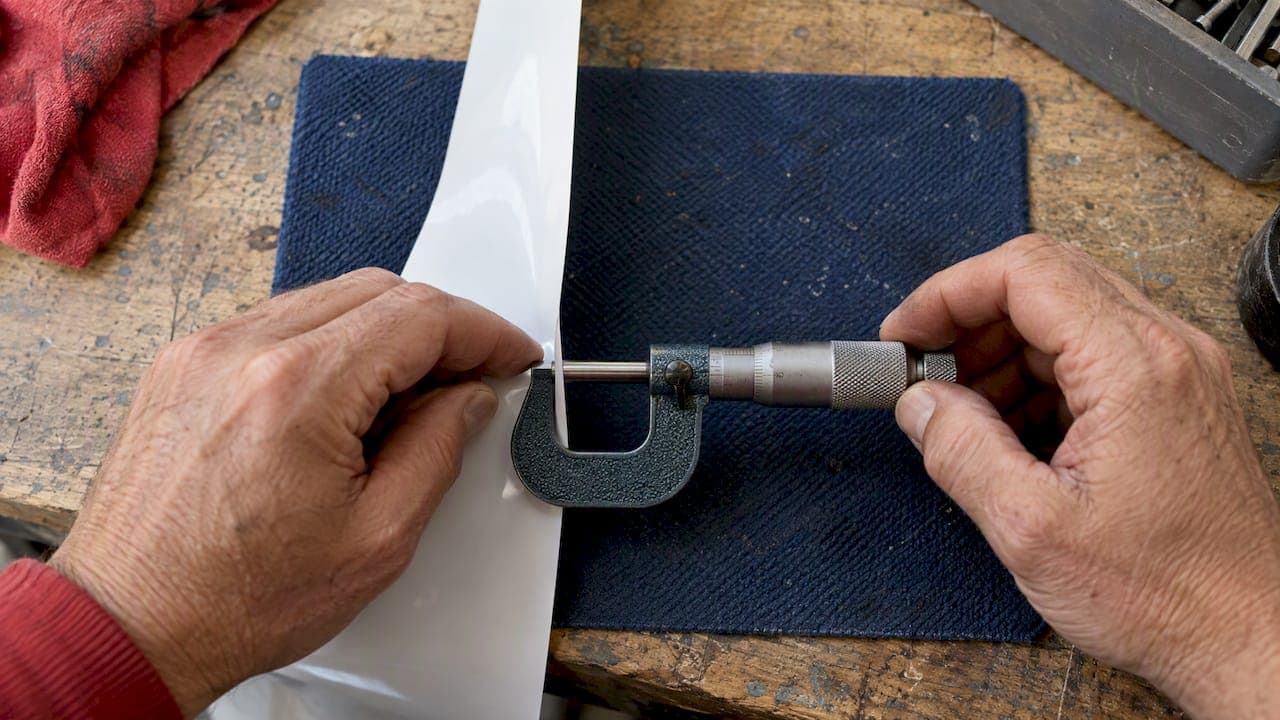
For boat registration numbers, a thin cast vinyl film in the 2 to 3 mil range is the practical sweet spot. It is thick enough to survive washdowns and sun, and thin enough to conform to a gelcoat hull and look painted on. But thickness is only part of the story. Film construction, adhesive, UV protection and surface prep decide whether your numbers last two seasons or eight.
This guide explains what a mil is, which thickness to look for, why "marine-grade" tells you very little by itself, and how to check that a set of numbers will pass inspection and stay put.
TL;DR
- Look for cast vinyl around 2 to 3 mil (0.002 to 0.003 inch). Thicker is not automatically better for flat, cut-out letters.
- Construction matters more than thickness. Cast film resists shrinking and lifting on hulls; cheaper calendered film tends to pull back at the edges.
- "Marine-grade" is a marketing label. Ask about film type, adhesive and UV protection instead.
- Thickness does not change legal size. Federal rules require plain vertical block characters at least 3 inches tall, in a color that contrasts with the hull.
- Most early failures come from surface prep, not the vinyl. Clean the hull, apply dry, and keep numbers above the waterline.
Table of Contents
- What "mil" means and why it matters for numbers
- Cast vs. calendered: the part that beats thickness
- Why "marine-grade" does not tell you enough
- UV and water: the silent killers
- Thickness does not change what the law requires
- How to choose by boat type
- Our perspective: ask for specifics, then prep the hull
- Order numbers sized and built for your boat
- Common mistakes with vinyl and boat numbers
- FAQ
- Sources
What "mil" means and why it matters for numbers
Vinyl thickness is measured in mils. One mil is one thousandth of an inch, so a 2 mil film is 0.002 inch thick, about half the thickness of a sheet of copy paper. That figure usually describes the vinyl alone, not the adhesive or any laminate on top, so two products with the same mil rating can feel different.
Registration numbers are cut-out letters with no background. That changes the thickness question compared with a large printed hull graphic:
- Thin film (about 2 mil) bends over small curves, rivets and slight hull contours without tenting. The edges of block letters are less exposed to water and a pressure washer's spray.
- Thicker film (4 mil and up) is stiffer and more puncture-resistant, which suits floors, steps and walkways. On a bow number it can stand proud, catch a fingernail or a dock line, and be harder to press down around curves.
So for numbers, you are not shopping for the thickest film you can find. You are shopping for the right kind of film at a sensible thickness.
Cast vs. calendered: the part that beats thickness
Two films with an identical mil rating can behave very differently because of how they are made.
Cast vinyl is poured as a liquid and cured, so it carries almost no internal stress. Practitioners describe it as the film to specify for boat hulls, compound curves, rivets and mouldings.

Calendered vinyl is rolled out of heated PVC and keeps a "memory" of its flat shape. The same source explains that it is better suited to flat signage and short-term use, and that on a hull it will tend to shrink and lift at the edges over time.
For tiny details like the corners of a 4, an 8 or the bars of a hyphen, shrinkage is what makes a decal look ragged first. A 2 mil cast film will usually outlast a 3 mil calendered film on a boat.
| Film type | Typical use | On a boat hull | Edge behavior over time |
|---|---|---|---|
| Cast, about 2 to 3 mil | Vehicle graphics, boat lettering | Conforms to curves and gelcoat | Stable, minimal shrink |
| Polymeric or premium calendered | Flat signs, medium-term graphics | Fine on flat panels only | May shrink slightly |
| Economy calendered | Short-term banners, indoor use | Poor choice for hulls | Prone to lifting and curling |
| Thick films (4 mil+) | Floors, textured or protective uses | Stiff, can stand proud on numbers | Depends on construction |
One caution on durability claims: you will see seller ratings from five to nine years. Treat those as manufacturer or seller estimates, not guarantees of what will happen on your hull in Florida sun or Great Lakes ice.
Why "marine-grade" does not tell you enough
There is no regulator or standard that defines "marine-grade vinyl" for decals. Industry specialists point out that it is an unregulated marketing term and suggest asking any vendor for four things instead:
- Film construction: cast or calendered.
- Adhesive chemistry: permanent, and suited to wet, UV-heavy service.
- UV protection: a matching laminate or UV-stable finish.
- Test standards: for example, salt spray resistance testing for the material.
We agree with that approach, and it applies to us as well. When you compare decal sellers, including us, ask what the film is, not just what it is called. If a seller cannot say whether the film is cast, move on.
UV and water: the silent killers
A boat is a harsh place for a sticker. Sunlight hits the hull directly and also bounces off the water. Marine graphics specialists note that decals take reflected UV from the water on top of direct sun, and recommend a UV-inhibiting overlaminate on printed graphics. Without that barrier, ink and base film can turn brittle and fade within a couple of seasons.
This point separates two kinds of decal:
- Solid-color cut vinyl (what most registration numbers are) has pigment in the film itself, so there is no printed ink layer to fade. Color is the film.
- Printed vinyl (for example, reflective or multi-color designs) relies on ink and usually needs a protective laminate. Laminate adds thickness, which is another reason total thickness numbers can mislead.
If you want numbers in black, white, navy or red, solid cut film is the simplest durable choice. If you want a printed effect, ask whether a UV laminate is included and how that affects the overall thickness.
Thickness does not change what the law requires
The vinyl you choose has no effect on whether your numbers are legal. The federal rule, 33 CFR 173.27, says numbers must:
- be painted on or permanently attached to each side of the forward half of the vessel;
- be plain vertical block characters of not less than 3 inches in height;
- contrast with the background and be distinctly visible and legible.
States add their own details. For instance, Pennsylvania's rules require the number to be displayed above the waterline on both sides of the bow, and your state agency's boating page is the final word on validation stickers and placement. If you want to dig into sizing, spacing and placement, we cover each in detail:
- How tall boat registration numbers need to be
- How much space goes between the numbers
- Where registration numbers go on a boat
A thicker film also does not make a too-small number legal. Measure the character height itself, not the sheet. Our guide to measuring numbers to the 3 inch minimum walks through it.
If you are also sorting out titling and paperwork, particularly on a larger vessel, this owner's guide to yacht registration gives useful background on how registration works at the upper end of the market. Note that documented vessels follow different marking rules from state-numbered boats, which we explain in our documented vessel markings guide.
How to choose by boat type
The same 2 to 3 mil cast film suits most hulls, but your boat changes the priorities.
- Aluminum boats and jon boats: Surfaces are smooth but can be painted or lightly textured. Prep and a contrasting color matter more than thickness. See our aluminum boat numbers.
- Bass boats: Metallic flake paint and high-gloss finishes are common, so choose a color that stays legible against them. See bass boat numbers.
- Pontoons: Numbers often go on a curved or rolled panel and sometimes over rivets or seams. Thin cast film copes best. See pontoon numbers and our pontoon placement answer.
- Center consoles: High sun exposure and frequent washdowns, so UV stability and good adhesion are the priorities. See center console numbers.
- Jet skis: Small, curved, often textured surfaces and lots of vibration. Thin, flexible film is a must. See jet ski numbers.
Our longer piece on the best vinyl for boats goes deeper on materials and state compliance.
Our perspective: ask for specifics, then prep the hull
We make boat registration decals for a living, so we see the same pattern over and over. Owners compare thickness numbers because it is the one figure a product page shows. It feels objective. But the questions that predict how a decal ages are less visible: what film, which adhesive, what kind of UV resistance, and how the hull was prepared.
Our decals are produced in-house from marine-grade vinyl selected for UV and saltwater resistance, and we encourage you to judge any seller, us included, on those specifics rather than on a mil number alone. Our own guide to how long marine vinyl decals last covers what to expect.
The other half of longevity is installation. A decal that fails in its first season has usually been blamed on the vinyl, but surface preparation is typically the cause. Hull installers point out that even a microscopic film of wax or silicone mold release on gelcoat will cause adhesion to fail, and that a final wipe with an isopropyl alcohol and water mix leaves the surface chemically clean. The same guidance favors dry application for marine graphics, since soapy application fluid can re-wet under the adhesive once the boat is in the water. All graphics should go above the waterline.
In practice that means:
- Wash the area, then clean it with isopropyl alcohol diluted with water.
- Let it dry fully and keep fingers off the surface.
- Position the numbers with masking tape as a hinge, measure for level and spacing, then apply dry with a squeegee, working from the center out.
- Peel the transfer tape back at a low angle, and let the adhesive cure before a hard wash.
Our step-by-step installation page shows each stage.
— Taylor
Order numbers sized and built for your boat
Our design tool lets you enter your registration number, then pick a color and font, in a few minutes. A custom set of boat registration numbers and decals is $35.99 per set, production takes 3 to 5 business days, and shipping is free across the contiguous United States. Marinas and dealerships can order in volume too; see our bulk order guide for fleets.
Common mistakes with vinyl and boat numbers
- Buying on thickness alone. A thick calendered film can fail before a thinner cast one.
- Skipping the hull prep. Wax, polish and old adhesive residue are the usual culprits when edges lift.
- Choosing low-contrast colors. The law requires numbers to contrast with the background. Pale gray on white gelcoat will draw attention from a marine patrol officer.
- Applying below the waterline or over seams. Keep numbers above the waterline and on a smooth surface.
- Wrong spacing. Groups of letters and numbers need a hyphen or space; our spacing guide shows the rule.
- Forgetting both sides. Numbers go on each side of the forward half; see whether numbers go on both sides.
FAQ
What vinyl thickness is best for boat registration numbers?
Cast vinyl in the 2 to 3 mil range is a sound choice for most boats. It follows hull curves, keeps its edges down and still reads as a clean, flat letter. Ask the seller for the film type, not just the mil rating.
Does thicker vinyl last longer on a boat?
Not necessarily. Film construction, adhesive and UV resistance affect lifespan more than thickness does. A thinner cast film will usually hold its edges better than a thicker calendered one on a curved hull.
Is "marine-grade vinyl" a real standard?
No. It is a marketing term without a regulated definition. Ask whether the film is cast or calendered, what the adhesive is, and how it resists UV and salt water.
Can I use craft vinyl for my boat numbers?
Some hobbyists cut numbers from outdoor-rated permanent adhesive vinyl on a home cutter, and that can work. You still have to meet the 3 inch height, block character and contrast rules, and expect to replace them more often than a cast marine film. Check your state's rules before you commit.
Does vinyl thickness affect state compliance?
No. Compliance is about character height, font style, contrast, placement and, in many states, a separate validation sticker. Material only affects how long the numbers stay legible.
Sources
- 33 CFR 173.27: Numbers: Display; size; color (Cornell Legal Information Institute)
- 4 Specs to Require Before Accepting Marine Grade Vinyl (A3M)
- Decals.com on UV and marine graphics
- Application Tips for Marine Marking (Arlon)
- 58 Pa. Code § 93.5: Display of registration number and validation decal