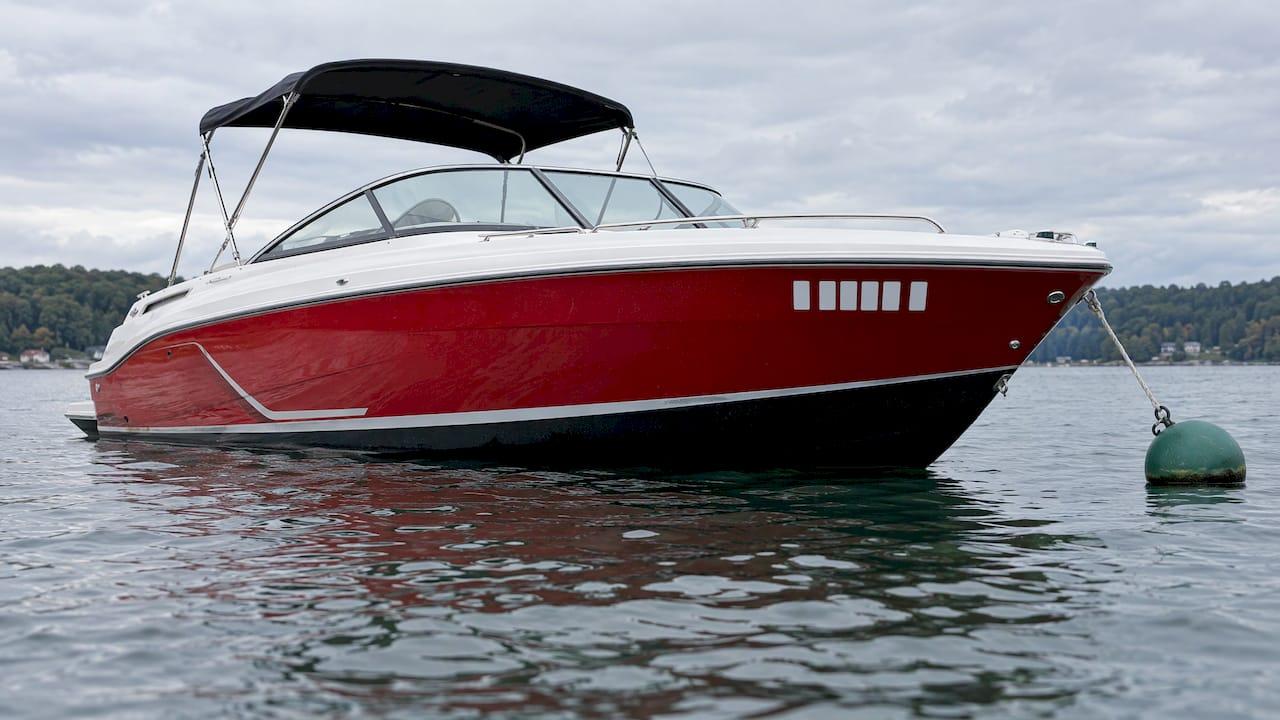
If your boat has a vinyl wrap, your registration numbers still have to be displayed, and they still have to meet the same rules as on a painted hull. Federal regulations require the numbers to be painted on or permanently attached to both sides of the forward half of the vessel, in plain block characters at least 3 inches tall, in a color that contrasts with what is behind them. A wrap changes the background and the surface you stick to. It does not change the standard.
This guide covers where the numbers go, how to keep them legible against a graphic wrap, what states add on top of the federal rule, and how to apply decals so they stay put.
TL;DR
- Numbers must be painted on or permanently attached to each side of the forward half of the boat, whether or not the hull is wrapped. A durable adhesive decal counts as permanently attached.
- Use plain vertical block characters at least 3 inches tall, in a color that contrasts with the wrap at the exact spot where the numbers sit.
- Your validation sticker goes within a set distance of the number, and the distance depends on your state (often 3 or 6 inches). Check your state's rule before you place it.
- Apply decals to a clean, dry surface above 40°F, and keep other numbers off the forward half of the hull.
- Magnetic numbers, tape and temporary signs do not meet the standard for regular recreational use.
Table of Contents
- Can registration numbers go on a vinyl wrap?
- What federal rules require
- How states add to the federal rule
- Choosing colors that contrast with your wrap
- Placement on a wrapped hull
- Why printed or removable numbers can fail
- Inflatables and boats where numbers won't stick
- How to apply registration decals to a wrapped boat
- Order numbers sized for your wrap
- FAQ
- Sources
Can registration numbers go on a vinyl wrap?
Yes, the numbers can be displayed on a wrapped boat, as long as they are permanently attached, correctly sized, and readable against the wrap. The rule itself is written around the vessel, not around its finish. Under 33 CFR 173.27, the number must be painted on or permanently attached to each side of the forward half of the vessel, in plain vertical block characters of at least 3 inches, contrasting with the background, reading left to right. 46 U.S.C. § 12305 adds that no other number may be carried on the forward half of the vessel.
In practice, owners of wrapped boats choose one of two routes:
- Put separate registration decals on top of the finished wrap, on a flat, clean area of the bow.
- Leave a clear, solid-colored area of the wrap design where the numbers will sit, so the decals have a clean, high-contrast background.
Either way, the numbers are their own element. Treat them as a legal marking, not a design flourish.
What federal rules require
The federal display standard has five parts, and every state number system builds on it:
- Location: each side of the forward half of the vessel.
- Attachment: painted on or permanently attached.
- Character style: plain, vertical block characters. Our guide to 3 inch block letters for boat numbers that pass inspection shows what that looks like in practice.
- Height: not less than 3 inches.
- Contrast and spacing: a contrasting color, with a space or hyphen between groupings equal to the width of a letter other than "I" or a number other than "1".
The numbers read from left to right on both sides of the boat. That means the starboard side reads from the stern toward the bow in the same direction as the port side, each reading left to right when you face that side. For more on the two-sided rule, see do registration numbers go on both sides of the boat.
How states add to the federal rule
States issue the registration number and many publish their own display wording. They agree on the core points (3-inch block characters, contrast, both sides of the bow), but they differ in how they describe the validation decal and what else they allow.
| State | What the official source says |
|---|---|
| Texas | TX number on each side of the forward half in block characters of at least 3 inches; the validation decal goes in line with the number and 3 inches toward the rear |
| Washington | At least 3 inches, block style, both sides of the bow; decals within 6 inches of the number, aft of and in line with it |
| California | Stickers 3 inches aft of and in line with the numbers; characters at least 3 inches in a contrasting color |
| Pennsylvania | Above the waterline on both sides of the bow; validation decal within 6 inches and level with the number |
| Florida | FL number on both sides of the bow in block letters at least 3 inches high, with a space equal to the width of the digits between prefix, numerals and suffix |
| South Dakota | May be painted or applied as a decal on both sides of the bow; readable at 100 feet with the vessel in the water |
| North Carolina | Numbers on the forward half of both sides, decals within 6 inches of the number |
The takeaway for a wrapped boat: the distance from number to sticker is the detail most likely to differ from state to state, so measure it from your own state agency's page, not from a forum post. Our page on where the validation sticker goes walks through the common layouts.
Choosing colors that contrast with your wrap
Contrast is where wraps cause the most trouble. A hull painted one solid color makes the choice easy. A wrap with gradients, camouflage, carbon-fiber texture or large graphics can make a color that looks fine in one spot disappear in another.
A few practical checks:
- Judge contrast at the exact placement. Hold a sample of the decal color against the wrap where the numbers will go, not against the wrap overall.
- Think about the darkest and lightest points. If the wrap shifts from dark to light under the numbers, the characters may lose contrast on part of the run.
- Avoid busy backgrounds. Keep the numbers on a calm, flat part of the bow if you can.
- Don't count outlines toward height. California's guidance states that any border, trim, outlining or shading around a number is not considered in determining height and contrast. Our article on outlined boat registration numbers explains how to use an outline without putting compliance at risk.
- Test legibility from a distance. South Dakota describes the target as clearly visible and readable at 100 feet with the vessel in the water. That is a useful yardstick for any state.
We also recommend a quick check of the numbers' height after you design them. Our boat number design guide shows how to confirm they truly stand 3 inches tall once printed.
Placement on a wrapped hull
The forward half of the boat is the zone that matters. On a wrapped boat, a few spots deserve extra attention:
- Keep numbers clear of seams and panel edges. A seam under a character makes the surface uneven and can affect how the decal holds.
- Stay off deep curves and sharp creases. Pick the flattest part of the forward half.
- Stay above the waterline. Pennsylvania, for example, specifies above the waterline on both sides of the bow.
- Don't crowd other graphics. Federal law says no other number may be carried on the forward half, and wrap designs sometimes include numerals such as model numbers or race-style numbers. See can other numbers be on a boat's bow before you finalize artwork.
If you want a general rundown, where do registration numbers go on a boat covers the basics for every hull type.
Why printed or removable numbers can fail
The federal rule says painted on or permanently attached. That excludes several shortcuts wrapped-boat owners sometimes consider.
- Magnets, tape and temporary signs. LegalClarity's April 2026 explainer says durable adhesive decals count as permanently attached under 33 CFR 173.27, while temporary signs, tape or magnetic numbers do not meet the standard for regular recreational use.
- Removable plates. These are an exception for manufacturers and dealers using a vessel for testing or demonstrating, according to the same federal section. An owner's everyday boat does not qualify.
- Numbers that are only part of the wrap graphic. If the printed numerals fade, peel with the wrap or end up on a surface that gets replaced, you no longer have a compliant display. Separate decals are easier to replace on their own.
For material choice, our guide to the best vinyl for boats explains why marine-grade, UV-resistant and saltwater-proof vinyl is the right base for a marking you can't afford to lose.
Inflatables and boats where numbers won't stick
Some hulls aren't a good surface for decals. Virginia's DWR states that on vessels where a number on the hull or superstructure would not be easily visible or would not remain securely attached, such as an inflatable, the number may be painted on or attached to a backing plate on the forward half. Washington's Department of Licensing gives the same option for rubber boats or boats not built so the numbers would otherwise be visible.

If your wrapped boat has a hull shape or texture that keeps a decal from bonding, a backing plate is a recognized path. Confirm with your state agency which version it accepts.
How to apply registration decals to a wrapped boat
The North Carolina Wildlife Resources Commission's guidance is clear on the basics: apply decals at a temperature above 40°F to a clean, dry surface free of dust, grease, wax or other foreign matter. Build the rest of your process around that.
- Pick the day. Choose a dry day above 40°F, out of direct rain and wind. Let the wrap come up to temperature.
- Clean the spot. Wipe away dust, grease and wax where the numbers will sit. Keep the wrap vinyl in good shape with a routine such as keeping boat vinyl flexible, and let any cleaner or protectant dry fully before you apply decals.
- Measure and mark. Use painter's tape to mark a level baseline on both sides of the forward half. Check the same height and distance from the bow on each side.
- Position the number first, then the validation sticker. Use your state's distance (for example 3 or 6 inches) and keep the sticker in line with the number without touching it.
- Peel and place. Start from one edge and lay the decal down gradually, working out air as you go with a squeegee or a credit card.
- Press the edges. Go over every letter edge and the corners so nothing lifts.
- Inspect. Stand back at a distance and confirm the numbers read left to right, the spacing is right, and nothing sits across a seam.
When it's time to replace a faded set, how to remove old boat registration decals shows how to lift them without marking the surface.
What we see on wrapped boats
Most compliance problems we see on wrapped boats aren't about the numbers themselves. They come from the background: a color that looked right on screen but fades into a gradient on the hull, a graphic that crowds the bow, or numbers set too close to a panel seam.
That's why we make our decals as separate, replaceable pieces rather than part of the wrap design. Our decals are produced in-house from marine-grade vinyl chosen for UV and saltwater resistance, and our online design tool lets you enter your registration number and choose the color and font before you order. Picking a color that contrasts with your wrap, in a plain block style, is the single most useful decision you can make.
Our advice is simple: finish the wrap, choose your spot, then order numbers sized and colored for that spot.
Taylor
Order numbers sized for your wrap
Our custom boat registration decals are designed to meet state requirements. You enter your registration number, choose your color and font in the online design tool, and order in minutes. A set is $35.99, production takes 3 to 5 business days, and shipping is free across the contiguous United States.
Start on our custom boat registration numbers page, or go straight to the version for your hull: center console numbers, bass boat numbers, pontoon numbers, aluminum boat numbers and jet ski numbers. Marinas and dealerships can use the same design tool for bulk orders.
FAQ
Do registration numbers have to be on both sides of a wrapped boat?
Yes. The federal rule requires the number on each side of the forward half of the vessel, and state rules say both sides of the bow. A wrap on the hull does not remove that requirement.
Can I print my registration numbers into the wrap itself?
The rule is that numbers be painted on or permanently attached, in plain block characters at least 3 inches tall. Separate durable decals are easier to size, check and replace, so most owners choose them. Check with your state agency before you rely on printed-in numerals.
Does the validation sticker go on the wrap too?
Yes, it goes near the number on the bow. The distance depends on your state: Texas and California specify 3 inches aft of and in line with the number, while Washington, Pennsylvania and North Carolina say within 6 inches. Follow your own state's wording.
Can I use magnetic or removable numbers to protect the wrap?
Not for regular recreational use. Durable adhesive decals count as permanently attached, while magnets, tape and temporary signs do not meet the standard. Removable plates are an exception for manufacturers and dealers testing or demonstrating a vessel.
What if my boat is inflatable?
States such as Virginia and Washington allow numbers on a backing plate attached to the forward half when a number on the hull would not be easily visible or would not stay attached. Confirm the accepted method with your state agency.
Sources
- eCFR: 33 CFR 173.27, Numbers: Display; size; color
- 46 U.S.C. § 12305: Displaying numbers
- Texas Parks & Wildlife: Numbers and Decals on Vessels
- Washington State Department of Licensing: Boat registration and hull identification numbers
- California DBW: Registration guidelines
- 58 Pa. Code § 93.5: Display of registration number and validation decal
- Sarasota Tax Collector: FL Number
- South Dakota Game, Fish, and Parks: Licensing Your Boat
- North Carolina Wildlife Resources Commission: Numbers and the Decals
- Virginia DWR: Watercraft Registration, Titling and Sales Tax Requirements
- LegalClarity: How Should Boat Registration Numbers Be Displayed?