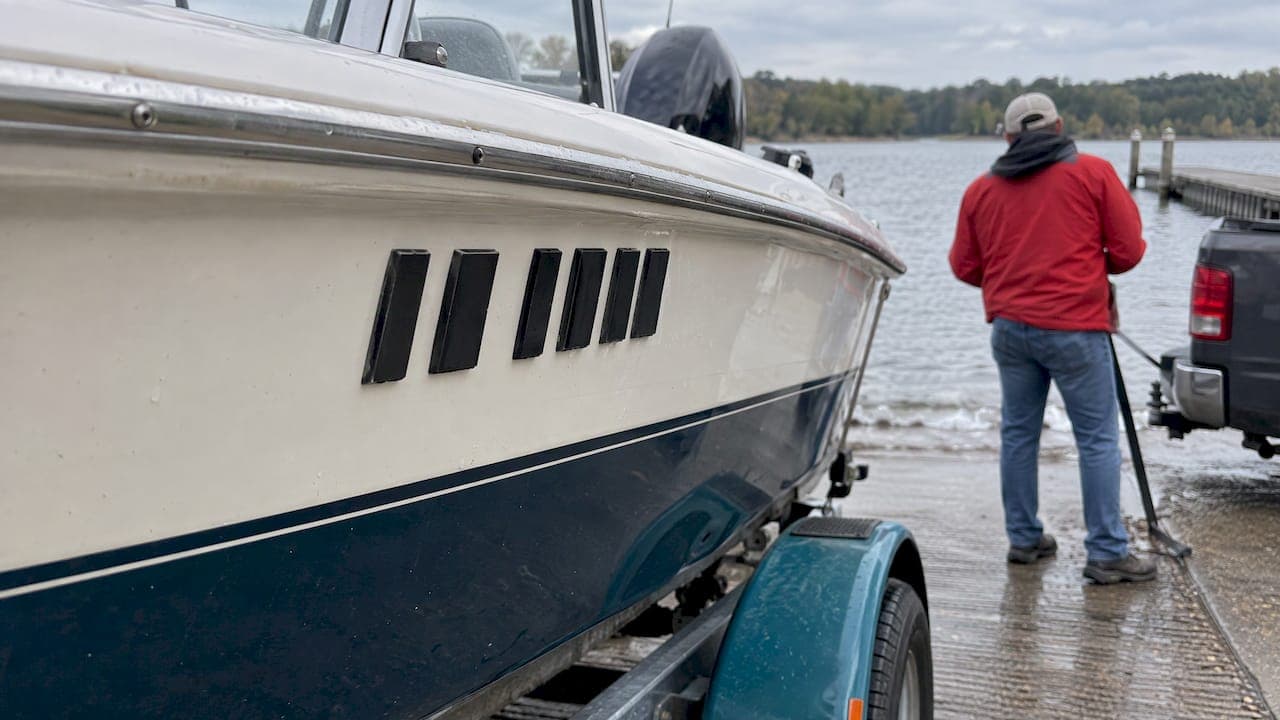
Yes, raised 3D boat numbers can be legal. The federal rule for registration numbers sets requirements for height, style, contrast, spacing and location. A raised or domed number that meets all of them is judged the same way as a flat one. The risk is not the raised surface. The risk is a fancy style that fails on legibility, contrast or placement, or one that breaks a rule in your own state.
This guide walks through what the federal rule requires, where states add to it, and what to check before you stick anything to your hull.
TL;DR
- Federal rules cover how numbers look and where they go. As far as the regulation text we reviewed goes, it does not name raised or flat as the test. Legibility is the test.
- Numbers must be plain block characters at least 3 inches high, contrast with the hull, and read left to right on both sides of the forward half.
- States can add rules: decal position, spacing, or limits on color schemes. Wisconsin, for example, says two-toned and camouflage numbers are not legal.
- Check your state agency's page before you order, then measure and test-fit the layout.
- Our custom decals are built from marine-grade vinyl to meet state requirements. You enter your number, color and font in the online design tool.
Table of Contents
- What the federal rule actually requires
- Where raised and domed numbers can go wrong
- What states add on top
- Special cases to check
- A checklist before you apply any numbers
- Perspective
- Get compliant numbers for your boat
- FAQ
- Sources
What the federal rule actually requires
The baseline is 33 CFR 173.27, which governs how a registration number is displayed. In plain terms:
- The number is permanently attached or painted on both sides of the forward half of the vessel.
- Characters are plain, vertical block characters at least 3 inches high.
- The number contrasts with its background and is distinctly visible and legible.
- Groups of letters and numbers are separated by a space the width of a letter, or by a hyphen. The width test ignores the letter I and the number 1.
- The number reads left to right.
- There are backing-plate exceptions when the hull or superstructure would not make the number easily visible.
The duty to display the number comes from 33 CFR Part 173 Subpart B. Before you operate a covered vessel, it needs a number issued on a certificate of number by the state of principal operation, and that number has to be displayed as section 173.27 specifies.
Notice what the rule is built around: size, shape, contrast, spacing, position and permanence. A raised number has to pass the same tests. That is why "is it raised?" is the wrong first question. Ask instead whether each character is plain block style, at least 3 inches tall, high-contrast and correctly spaced.
Where raised and domed numbers can go wrong
A raised finish does not break any rule by itself, but it can make it easier to break one. These are the usual trouble spots.
Decorative fonts
Script, italic, outlined or stylized lettering fails the plain block standard. Some 3D lettering is sold in ornate fonts for looks. If you want a distinctive look, stay with a clean block face and put the personality in the color.
Low contrast
Chrome on a white hull, or silver on light gray gelcoat, may look sharp in a product photo and wash out in daylight. The rule says the number must contrast with the background. Pick the darkest or lightest option against your hull color, and view it from a distance in direct sun.
Two-tone and camouflage schemes
Two-color raised numbers are popular. But Wisconsin states that two-toned and camouflage numbers are not legal. If you boat in Wisconsin, use a single solid color that contrasts with the hull. Check your own state before choosing any multi-color design.
Height measured wrongly
The 3 inches applies to the character height. Do not count a border, shadow or outline. If you are unsure how to measure, our guide on how tall boat registration numbers need to be explains it, and the boat number design guide shows how to check that characters really stand three inches tall.

Spacing that merges the groups
The letter groups and the numerals need a clear break. Federal text calls for a letter-width space or a hyphen. Some states are stricter. Wisconsin asks for at least a 2-inch space between letters and numbers. Missouri asks for 2-inch spaces between prefix or suffix and the numerals.
Wrong location
Numbers on a windshield, a transom or a removable panel are a common failure. See why numbers on a windshield fail inspections. The forward half of the hull on each side is the standard location, and our answer on which side numbers go on covers the both-sides rule.
What states add on top
Federal law is the floor. Each state issues the certificate of number and can add detail. A sample from official state pages shows how much it varies:
| State | What it adds or stresses |
|---|---|
| Texas | TX number on each side of the forward half, block characters at least 3 inches high, contrasting, left to right, hyphens or equivalent spaces between groups (TPWD) |
| Wisconsin | At least 3 inches, block letters, contrasting, 2-inch space between letters and numbers, no two-toned or camouflage numbers (DNR) |
| Kentucky | Plain block characters, maximum contrast, letter-size spaces between groups, decals within 6 inches behind and in line with the number (KDFWR) |
| Missouri | Permanently affixed, sharp contrast, 2-inch spaces between prefix or suffix and numerals, decals placed below the number (Dept. of Revenue) |
| Washington | Block characters at least 3 inches high on both sides of the bow, validation decals within 6 inches of the number, aft of it and in line (DOL) |
| Pennsylvania | Validation decals within 6 inches of the number and level with it (58 Pa. Code § 93.5) |
Two things stand out. First, the spacing and decal positions differ, so a layout that works in one state may not in another. Second, the validation decal sits in a precise spot relative to the number. A thick raised number can crowd that space, so leave room when you plan the layout.
If you want state-specific detail, see our guides for Texas (Texas numbers blog), Washington, Oregon and Wisconsin. For where the sticker itself goes, read where the validation sticker goes.
Special cases to check
Pennsylvania. A recreational vessel with a valid marine document, when Pennsylvania is its state of principal operation, displays a valid registration decal but not the registration number. Do not apply numbers you do not need.
Boats where the hull will not show the number. The federal rule has backing-plate exceptions. Illinois, for instance, permits brackets or fixtures firmly attached to unconventional vessels when forward-half placement and the standard legibility, size, style and contrast requirements are met.
Personal watercraft, pontoons and kayaks. Layout and placement differ by vessel type. See jet ski number rules, pontoon placement and whether kayaks and canoes need numbers.

Other numbers on the bow. Extra numbers near your registration can confuse the read. Our answer on other numbers on the bow explains what to avoid.
A checklist before you apply any numbers
- Confirm your state of principal operation and read its boating agency page. The state that issued your certificate of number sets the details.
- Pick a plain block font. Skip script, italic and outlined faces.
- Choose one high-contrast color against your hull. Dark on light, light on dark.
- Set the height to at least 3 inches for the characters themselves.
- Plan the spacing. Use a hyphen or at least a letter width, and add more if your state requires, such as 2 inches in Wisconsin or Missouri.
- Mark the forward half of both sides and keep the numbers on the hull, reading left to right.
- Reserve space for the validation decal according to your state: within 6 inches in several states, in line with the number.
- Clean and dry the surface, then dry-fit with masking tape before peeling anything.
- Look from 50 feet away in full sun. If you hesitate to read it, change the color.
Perspective
We look at registration numbers the way an officer on the water does. They see a boat from a distance, in glare, while it is moving. They do not care how the number is made. They care whether they can read it.
That is why we build around the things the rules measure: block characters, 3-inch height, contrast, spacing and correct placement. Our online design tool starts from your registration number, then lets you pick color and font so the result stays compliant while still looking like your boat.
We produce our decals in-house from marine-grade vinyl chosen for UV and saltwater resistance, because a number that fades or peels has stopped doing its job. Our decals are designed to meet state requirements, and our state guides help you check the details for where you boat.
Our advice: decide compliance first, then style. Get the font, color, height, spacing and position right, and everything else is taste.
Taylor
Get compliant numbers for your boat
Our custom boat registration numbers and decals start at a published price of $35.99 per set. You type in your registration number, choose a color and font, and see the layout before you order. Production takes 3 to 5 business days, with free shipping across the contiguous United States.
We also have pages for specific hulls: jet ski numbers, pontoon numbers, bass boat numbers, aluminum boat numbers and center console numbers. Marinas and dealerships can order in bulk. For general questions, browse our boat registration number answers.
FAQ
Are raised 3D boat registration numbers legal?
They can be. The federal rule in 33 CFR 173.27 sets requirements for height, block style, contrast, spacing and location, and raised numbers are judged on those same points. Confirm that your state does not add something further, such as Wisconsin's ban on two-toned numbers.
How tall do boat numbers have to be?
At least 3 inches, in plain vertical block characters, according to the federal rule and states such as Texas, Wisconsin, Kentucky, Missouri and Washington. Measure the character itself, not a border or shadow.
Can I use two colors or chrome on my numbers?
Only if the number still contrasts clearly with your hull and your state allows it. Wisconsin says two-toned and camouflage numbers are not legal, so one solid contrasting color is the safest choice. Check your state's boating agency before ordering.
Where does the validation decal go relative to the number?
It depends on your state. Washington, Kentucky and Pennsylvania call for it within 6 inches of the number and in line with it, while Missouri places it below the number. Our page on where the validation sticker goes has more.
Do I need numbers on both sides of the boat?
Yes for most vessels. The federal rule calls for the number on both sides of the forward half, and states such as Texas, Wisconsin and Missouri repeat that. Pennsylvania has a case where only the decal is displayed.
Sources
- eCFR, 33 CFR 173.27: Numbers: Display; size; color
- eCFR, 33 CFR Part 173 Subpart B: Numbering
- Texas Parks & Wildlife: Numbers and Decals on Vessels
- Wisconsin DNR: Before you operate your boat
- Kentucky Department of Fish & Wildlife: Boating
- Missouri Department of Revenue: Boat/Vessel Licensing
- Washington DOL: Boat registration and hull identification numbers
- 58 Pa. Code § 93.5
- Illinois Boat Registration and Safety Act, 625 ILCS 45